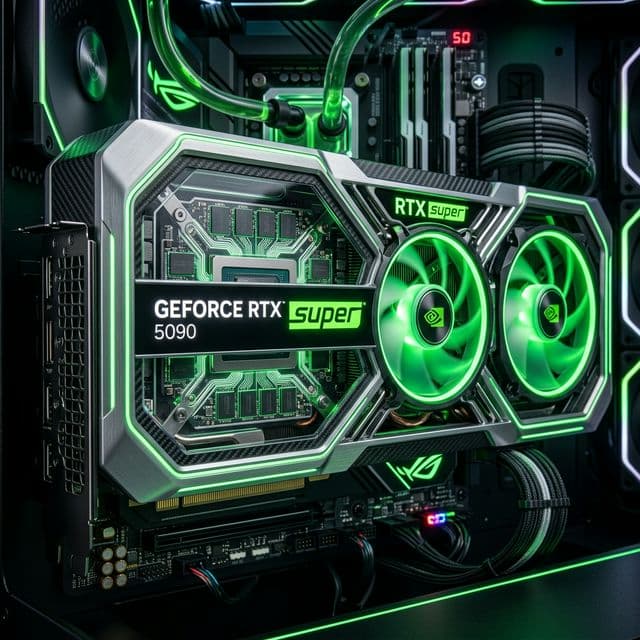
Artist's rendition of the rumored RTX 50 SUPER refresh. (Note: RTX 5090 Super is not mentioned)
Just as the hardware community settles into the Blackwell architecture's initial wave, rumors of an "RTX 50 SUPER" refresh are already beginning to surface. According to recent high-profile hardware leaks, Nvidia is preparing a mid-generation pivot that addresses the most persistent criticism of its current lineup: video memory capacity.
The leaked specifications suggest that Nvidia is moving toward 3GB GDDR7 memory modules, potentially increasing the VRAM capacity of several core models by a staggering 50%. While architectural changes appear minimal, the shift in memory density could redefine the "performance per dollar" landscape for the 2026-2027 window.
Disclaimer
The following information is based on rumors and unofficial hardware leaks. Nvidia has not confirmed these specifications, and final products may vary significantly from these early reports.
The Rumored Lineup: A Mid-Gen Power Play
The leak identifies four primary models slated for the SUPER treatment, or at least a VRAM "stepping" upgrade.
| GPU Model | CUDA Cores | Memory | Speed | Bus | TGP |
|---|---|---|---|---|---|
| RTX 5060 | 3,840 | 8GB | 28 Gbps | 128-bit | 145W |
| RTX 5060 12GB (Rumored)Leak | 3,840 | 12GB | 28 Gbps | 128-bit | Unknown |
| RTX 5070 | 6,144 | 12GB GDDR7 | 28 Gbps | 192-bit | 250W |
| RTX 5070 SUPERLeak | 6,400 | 18GB GDDR7 | 28 Gbps | 192-bit | 275W |
| RTX 5070 Ti | 8,960 | 16GB GDDR7 | 28 Gbps | 256-bit | 300W |
| RTX 5070 Ti SUPERLeak | 8,960 | 24GB GDDR7 | 28 Gbps | 256-bit | 350W |
| RTX 5080 | 10,752 | 16GB GDDR7 | 30 Gbps | 256-bit | 360W |
| RTX 5080 SUPERLeak | 10,752 | 24GB GDDR7 | 32 Gbps | 256-bit | 415W |
Launch Timeline: Q4 2026 or Early 2027
One of the most significant takeaways from these leaks is the projected launch window. Analysts suggest a release target of late 2026 (Q4) or the first quarter of 2027. If accurate, this implies that the standard RTX 50 lineup will have a relatively short "reign" before being overshadowed by their SUPER counterparts.
Furthermore, this timeline suggests that the next major architectural leap—presumably the RTX 60 series—is unlikely to arrive before mid-to-late 2027 at the earliest.
Why VRAM is the New Battlefield
For years, GPU marketing focused almost exclusively on architectural efficiency and raw compute power (FLOPS). However, the landscape of modern gaming has shifted dramatically. We have entered the era of heavy AI upscaling, path tracing, and extraordinarily high-fidelity texture assets that demand massive amounts of local memory buffer.
Modern titles like GTA VI (and especially Unreal Engine 5 games) will be consuming VRAM at unprecedented rates. Even at 1440p resolution, 12GB is rapidly becoming the "bare minimum" for a stutter-free experience with maximum settings. When you factor in the "VRAM tax" imposed by Frame Generation—which requires additional memory to store the generated and historical frames—the need for a larger buffer becomes undeniable.
By moving to 3GB modules, Nvidia is finally providing the headroom required for "future-proofing" that gamers have been demanding since the controversial 8GB limits of the mid-range 30 and 40 series cards. This shift isn't just about high resolutions; it's about stability. When a GPU runs out of VRAM, it must swap data over the PCIe bus to system memory (RAM), which is orders of magnitude slower. This results in the dreaded 1% low frame time spikes, or "micro-stuttering," that can ruin a premium gaming experience regardless of how high your average FPS might be.
Texture Highs & Asset Streaming
Modern engines use virtualized texturing and aggressive streaming. Higher VRAM allows these engines to keep high-resolution assets resident in memory longer, virtually eliminating texture pop-in and blurred assets during fast-paced movement or scene transitions.
The Ray Tracing Capacity Tax
Ray tracing structures, specifically Bounding Volume Hierarchies (BVH), consume significant portions of the VRAM buffer before a single pixel is even rendered. A 24GB buffer on a 5070 Ti SUPER would make aggressive path tracing viable without compromising texture quality.
Performance via Power:
An interesting detail hidden within the leaks is the consistent increase in Total Graphics Power (TGP) across the refresh. Most models show a significant bump in power consumption—for instance, the RTX 5080 SUPER is rumored to draw 415W, a notable jump from the standard 5080's 360W.
Since CUDA core counts are largely staying identical across most of the lineup (with the commendable exception of the 5070 SUPER), these TGP increases suggest that Nvidia is relying on "frequency scaling" to deliver performance gains. This typically involves selecting the highest quality silicon ("binning") and allowing it to run at higher sustained clock speeds by providing more thermal and electrical headroom.
For the end-user, this means that while the "SUPER" cards will undoubtedly be faster, they will also require higher-wattage power supplies. It marks a shift away from the efficiency we saw earlier in the rtx 40 series and slightly higher rtx 50 requirements, suggesting that Nvidia is willing to "brute force" such victory until the architectures of 2027 arrive.
The Value Proposition: FPS per Dollar Impact
Pricing remains the ultimate wildcard and the most critical variable in the "FPS per Dollar" equation.
If the RTX 5070 SUPER launches at the same $599 target as the standard 5070 ( VERY DOUBTFUL ), but brings 18GB of VRAM and a ~10% performance uplift, the value proposition shift would be massive. It would force price cuts. However, current market trends and the increased cost of GDDR7 memory suggest that Nvidia may use these "SUPER" cards to justify a price creep, potentially positioning the mid-range higher than ever before.
For value-conscious buyers, the ripple effect on the secondary market is just as important. The arrival of a 24GB 5080 SUPER would likely drive down the prices of standard 16GB models on the used market, creating a window for budget-oriented builders to snag high-end silicon at a significant discount. At FPSPerDollar, we recognize that any card with less than 16GB in the mid-high tier will likely see a much sharper depreciation curve as games increasingly target higher memory buffers.
The "cards to watch" are undoubtedly the 5060 12GB ( with the current 8GB receiving much scrutiny) and 5070 SUPER. These models represent the high-volume segment of the market where every dollar is scrutinized. A 5070 SUPER with 18GB of VRAM at the right price point would become the new default recommendation for high-end 1440p gaming, finally offering a balanced experience without the "VRAM anxiety" and criticism that plagued this generation.
The Verdict: Should You Wait?
If you are currently sitting on an RTX 30 or 40 series card with at least 12GB of VRAM, there is likely no immediate rush. However, if you are struggling with VRAM limits on an 8GB card, the rumored SUPER refresh looks like the "true" version of Blackwell that many were hoping for. While pricing is unknown, the 50% jump in memory density makes these cards a much more compelling long-term investment than the initial RTX 50 lineup.
Explore by Budget
Explore by Resolution
Share this article to fellow gamers